How To Rank Your Website On AI Platforms Like ChatGPT And Gemini
Think of a customer inquiring from ChatGPT:
“What are some digital marketing firms that can assist an eCommerce brand in scaling organic traffic and generating leads?”
Your website might never rank organically on a standard Google page one result for that exact query. But that customer may still discover your brand through an AI-powered response.
This is the basic paradigm shift occurring in search.
Search is moving from “Which page ranks for this keyword?” to “Which sources can an AI system use to answer this question?”
For businesses, this creates a new optimisation opportunity. AI SEO, ChatGPT SEO, Gemini SEO and AI search optimisation are becoming important extensions of traditional SEO. The goal is not to manipulate ChatGPT or Gemini into ranking a page. It is to build a website that is technically accessible, contextually relevant, authoritative and easy for AI systems to understand.
At MetaLogic Digital, we approach this as the next layer of search visibility: combining technical SEO, content authority, entity optimisation, structured data and search-intent analysis to help brands become discoverable across evolving AI platforms.
What Does It Mean To Rank On AI Platforms?
“Ranking on ChatGPT” or “ranking on Gemini” does not work exactly like ranking at position one on Google.
AI search systems can retrieve information, evaluate multiple sources and generate a response around a user’s specific question. ChatGPT states that its Search results use multiple factors to identify relevant and reliable information, and that there is no guaranteed top placement. Websites also need to allow OAI-SearchBot to crawl their content to be eligible for inclusion.
This means your AI search optimisation strategy should focus on three fundamental questions:
- Are AI capable of identifying your website?
- Are they capable of understanding what your website is all about?
- Does your content carry enough credibility for them to be used as a source?
MetaLogic Digital sees these questions as the basis for AI visibility, not as some mythical “AI ranking hack”.
How is AI Search Different from Conventional Search?
Typical SEO always starts from a particular keyword, like “SEO agency Bangalore.”
In contrast, AI-based search may start with a very detailed inquiry:
“Why does an eCommerce business need to look for an SEO agency that can help with organic traffic and qualified leads?”
The second search consists of:
- Type of business
- Service need
- Commercial objective
- Expected results
- Criteria for evaluation
That’s why ChatGPT SEO and Gemini SEO involve more than simply placing keywords on pages.
Your content needs to demonstrate context, expertise, evidence and relevance.
Traditional SEO vs AI Search Optimisation
Traditional SEO | AI Search Optimisation |
Focuses heavily on keyword queries | Focuses on conversational and contextual queries |
Optimises for search-result rankings | Optimises for discovery, retrieval and citation opportunities |
Targets individual keywords | Builds topical and semantic coverage |
Primarily measures rankings and clicks | Considers mentions, citations and visibility of AI |
Makes use of backlinks for authority | Increases authority and entity recognition |
Optimises each page individually | Creates content ecosystems |
Focuses on the search engine results page | Aims AI-generated answers and experiences |
Intent behind the keyword is important | Context and answerability increase in importance |
It does not mean that the traditional SEO technique is outdated. Google keeps emphasising that traditional SEO practices remain relevant in its AI-based search experience.
The right strategy should be:
Traditional SEO + AI SEO + Entity Optimisation + Content Authority
1. Ensure Accessibility of Your Website To AI Crawlers
Before you consider anything else, ensure that your website is accessible to the AI crawlers.
The technical excellence of your article is irrelevant if the key webpages are not crawlable.
To learn how to optimise your website for AI platforms, begin with the basics.
Review the following:
- robots.txt file
- XML sitemap
- noindex tag
- canonical URLs
- HTTP response codes
- internal links
- rendering in JavaScript
- content delivery network
- firewall settings
- bot management
- accessibility issues
- server speed
Specifically regarding ChatGPT, according to OpenAI, you must grant OAI-SearchBot access to crawl your website if you wish to have it indexed via ChatGPT Search. OpenAI further adds that traffic from published searchbot IP addresses must be allowed by the website host or CDN.
MetaLogic’s AI SEO process
For MetaLogic Digital, AI SEO begins with a crawlability audit rather than content writing.
Crawl → Render → Understand → Retrieve → Reference
The above technical process is significant.
2. Create Content Based on Actual Dialogues
People do not communicate with AI the same way that they search for something on Google.
The Google query might be:
“Best SEO agency for eCommerce”
The AI query may be:
“What are the best SEO agencies for an eCommerce business that requires technical SEO and qualified leads?”
Consequently, your content needs to meet the user’s information needs, not just echo the main keyword.
Create content using:
- Questions
- Comparisons
- Problems
- Use cases
- Buyer decisions
- Industry-specific problems
- “Best” and “How To” questions
- Alternatives
- Cost questions
- Implementation questions
As an illustration, MetaLogic Digital can create an AI SEO content cluster for:
Pillar:
AI SEO: Complete Guide
Supporting pages:
- What is AI SEO?
- How to rank your website on ChatGPT
- How to rank your website on Gemini
- ChatGPT SEO strategies
- Gemini SEO strategies
- How AI search works
- How to optimise content for AI search
- Technical SEO for AI platforms
- Entity SEO for AI visibility
- How to measure AI search visibility
This creates topical depth, rather than isolated keyword pages.
3. Make Your Content Easy For AI To Understand
AI systems need to interpret your content before they can use it.
That makes content architecture important.
Instead of creating pages filled with long blocks of marketing copy, structure information clearly.
Use:
- Descriptive H2 and H3 headings
- Short explanatory paragraphs
- Numbered processes
- Relevant bullet points
- Definitions
- Comparison tables
- Examples
- Statistics
- Expert commentary
- FAQs
- Clear conclusions
For example:
Weak
We deliver innovative, cutting-edge digital solutions that help modern brands unlock unprecedented growth.
Stronger
AI SEO helps businesses improve their visibility across AI-driven search experiences by combining technical accessibility, topical authority, structured information and entity signals.
The second version directly defines the concept.
That makes it more useful to readers — and more machine-readable.
4. Create Topical Authority Around Your Expertise
One article will rarely establish a brand as an authority.
If MetaLogic Digital wants to be recognised for AI SEO, for example, publishing one page titled “AI SEO” is only the starting point.
Build a connected ecosystem.
A strong AI SEO topic cluster could include:
AI SEO
→ ChatGPT SEO
→ Gemini SEO
→ AI search optimisation
→ Generative search
→ Entity SEO
→ Technical SEO
→ Structured data
→ AI visibility measurement
→ Search intent
→ Digital authority
Then connect these pages using contextual internal links.
This helps establish relationships between subjects and demonstrates that the website has genuine depth in the topic.
5. Optimise for Entities, Not Just Keywords
Perhaps one of the biggest changes in today’s search is the shift from keyword matching to entity recognition.
An entity could be:
- A business
- Individual
- Product
- Service
- Organization
- Location
- Brand
- Topic
For MetaLogic Digital, for instance, the website must communicate the following things:
Who is MetaLogic Digital? → What does it do? → Who are its target customers? → What is its expertise? → What does it deliver?
This information must remain consistent across the website and in relevant external sources.
Entity signalling via:
- About pages
- Service pages
- Author pages
- Company pages
- Digital PR
- Industry publications
- Relevant directories
- Case studies
- Reviews
- Brand mentions
- Organisation structured data
The objective is not to “tell ChatGPT what to say”.
The goal is to develop a coherent digital identity that allows search engines to recognise and interpret the business effectively.
6. Use Structured Data As A Technical Layer
Structured data gives search engines machine-readable information about a page.
Depending on the website, relevant schema can include:
- Organization
- LocalBusiness
- Person
- Service
- Product
- Article
- BreadcrumbList
- Event
- QAPage
For example, an organisation page can communicate information about the business, while a service page can clarify what service is being offered.
The problem is that structured data must accurately reflect the visible content. It’s not a means of boosting an AI ranking.
According to Google guidelines, structured data is a standardised way of supplying information about a page and its content.
Technical Rule for MetaLogic Digital
Do not use schema because it is available. Use schema because it accurately describes the content on the page. This will ensure that technical SEO doesn’t become just an exercise in markup.
7. Share Unique Information That AI Cannot Easily Obtain
AI tools can access numerous pages that provide information on basic SEO techniques.
Why would they need another page similar to this?
That’s when unique information becomes useful.
Instead of writing:
“10 Benefits of SEO”
create:
“What 150+ Brand Campaigns Reveal About Organic Growth”
Instead of:
“What Is AI SEO?”
create:
“AI Search Visibility: What We Found After Testing 100 Conversational Queries”
Original information sources could include:
First-party research
Campaign information
Case studies
Surveys
Original stats
Framework
Interviews
Consumer insights
Experiments
Comparisons
Generative AI search is currently guided by Google’s emphasis on non-commodity content, not just a quantity of interchangeable content.
8. Presents Real Case Studies As Evidence
AI search optimisation should not be based on just theory.
Content is enhanced by real-world evidence.
Example: MetaLogic Digital
Assume that a prospect asks:
So, which agency can boost the organic traffic of an eCommerce business?
The following is a generic page indicating:
We offer high-quality SEO services.
Provides little evidence.
Now consider the following: A case study of how:
Organic users: 10.8K → 18.7K
alongside:
- Initial challenge
- SEO strategy
- Technical improvements
- Content strategy
- Keyword growth
- Result
- Timeline
The second page gives an AI system and a human reader substantially more context.
That is why MetaLogic Digital should use case studies, measurable outcomes and first-party evidence throughout its AI search strategy.
9. Optimise For Comparison And Recommendation Queries
AI platforms are increasingly useful for decision-making.
Users ask:
“Which SEO agency should I choose?”
“What is the best SEO strategy for an eCommerce business?”
“Compare SEO agencies that specialise in lead generation.”
These are commercially valuable queries.
Create content that helps users make decisions.
Useful formats include:
- Comparison guides
- Buyer guides
- Service comparisons
- “Best for” pages
- Alternative pages
- Industry-specific guides
- Cost guides
- Evaluation checklists
- Decision frameworks
For MetaLogic Digital, a page such as:
“How To Choose An SEO Agency For Your eCommerce Business”
Can establish expertise without turning the page into a constant sales pitch.
- Strengthen Internal Linking
Enhanced website information connectivity through AI search optimisation is another benefit.
Consider this structure:
AI SEO Guide
↓
ChatGPT SEO
↓
OAI-SearchBot & Crawlability
↓
Technical SEO For AI Platforms
↓
AI Search Visibility Measurement
Each page strengthens the next.
Better internal linking:
- You will want your descriptive phrases used for anchor text
- Related topics should be interlinked
- Deepen reader engagement and keep them on the site for longer
- Landing pages and other high-conversion-rate pages should be linked to from other areas of your website
- Minimise generic “read more” links
A strong internal architecture makes your website easier for users to navigate and to interpret as a connected knowledge structure.
11. Keep Information Fresh And Technically Accurate
AI search is particularly sensitive to rapidly changing subjects. AI platforms, algorithms, crawler behaviour and search features evolve quickly.
An article written two years ago about “how to rank on ChatGPT” may already contain outdated recommendations. Consequently, MetaLogic Digital should have an update cycle for AI SEO content.
Analysis:
- AI platform updates
- Search documentations
- Crawler needs
- Recommendations
- Statistics
- Industry examples
- Screenshots
- Links
- Product or service information
- Search behaviour
For example, Google has continued to update its documentation on AI Overviews, AI Mode, and generative AI search throughout 2026.
AI SEO is not a publish-and-forget strategy.
12. Build Authority Beyond Your Website
A website is just a part of your digital presence. If there is an article on MetaLogic Digital about AI SEO, then authority will be gained by mentions related to the topic.
Build visibility by means of:
- Trade publications
- Digital PR
- Thought leadership on LinkedIn
- Interviews with experts
- Podcasts
- Reports
- Websites of partners
- Relevant directories
- Communities
- Original data
You should not try to collect backlinks from any website.
You should establish connections with MetaLogic Digital as an authoritative source of information on these topics.
13. Don’t Create Hundreds Of AI-Generated Pages
There is a dangerous misconception that AI SEO means producing enormous amounts of AI-generated content. It does not. Creating hundreds of near-identical pages simply to target different keyword combinations can create thin, repetitive content.
Nowadays, Google’s spam guidelines define scaled content abuse as the practice of using large quantities of non-unique material for manipulation purposes.
Improved strategy:
Research -> Expertise -> Insight -> Editing -> Evidence -> Optimisation
At MetaLogic Digital, AI can assist the workflow, but strategy, verification, experience and editorial judgement should remain central.
14. Track AI Search Visibility Differently
Traditional SEO reports might tell you:
A traditional SEO report may give you the answer to:
Keyword → Position → Impressions → Clicks
AI search needs a more comprehensive standards-based approach.
Track:
Brand mentions
How often is your brand in the AI answers?
Citation frequency
How many times is your website mentioned?
Query visibility
What are some of the right questions to ask to create brand awareness?
Competitor mentions
Who are the replacements for these competitors?
Source selection
What pages are used as sources over and over again?
Referral traffic
What is the percentage of traffic from AI platforms with referral data?
Effect on conversion
Are there any conversions through AI referrals?
This creates a more meaningful AI search optimisation dashboard.
ChatGPT SEO vs Gemini SEO: What Should You Optimise?
The foundations are similar, but businesses should understand the difference between platforms.
Area | ChatGPT SEO | Gemini SEO |
Primary emphasis | Visibility within ChatGPT search | Visibility within Google’s AI-based search ecosystem |
Technical focus | Enable OpenAI to crawl, including OAI-SearchBot | Strong Google crawling, indexing and technical SEO |
Content priority | Relevant, reliable, answer-focused content | Helpful, authoritative and context-rich content |
Search behaviour | Conversational questions and research prompts | Search queries, AI Overviews, AI Mode and broader Google ecosystem |
Authority | Reliable sources and relevant digital presence | Search authority, entities, content quality and broader web signals |
Structured information | Useful for machine understanding | Important for helping Google interpret page content |
Measurement | Mentions, citations, referrals and query visibility | AI visibility plus Search Console and organic performance |
Core strategy | Be discoverable, relevant and reference-worthy | Strengthen SEO while optimising content for generative search |
For ChatGPT specifically, OpenAI states that there is no guaranteed top placement and recommends allowing OAI-SearchBot to crawl the website for inclusion.
For Google’s AI search experiences, Google’s current guidance continues to emphasise strong SEO foundations and useful, non-commodity content.
A Practical AI SEO Framework From MetaLogic Digital
At MetaLogic Digital, AI search optimisation can be approached through a simple but technically grounded framework.
01. ACCESS
Make your website crawlable and technically accessible.
02. UNDERSTAND
Define the information architecture, entities and structured data.
03. ANSWER
Write content that answers the conversational questions.
04. PROVE
Support expertise with case studies, original research, statistics and evidence.
05. CONNECT
Use internal linking and topic clusters to establish semantic relationships.
06. AUTHORISE
Build relevant digital authority through credible third-party mentions.
07. MEASURE
Track AI mentions, citations, query visibility, referrals and conversions.
08. REFINE
Continuously update content as AI search behaviour and platforms evolve.
This turns AI SEO from a vague marketing concept into an operational search strategy.
A Real-World Search Scenario
Consider an eCommerce company looking for an SEO partner.
Instead of searching:
“SEO agency”
the decision-maker asks ChatGPT:
“I run an eCommerce brand and want to increase organic traffic, rankings and qualified revenue. What should I look for in an SEO agency?”
The AI response may consider multiple signals and sources.
A strong MetaLogic Digital presence should therefore make it easy to understand:
Who MetaLogic Digital is
→ Digital marketing agency
What MetaLogic Digital does
→ SEO, paid media, lead generation, branding and growth
What MetaLogic Digital knows
→ Technical SEO, content, AI search and digital growth
What MetaLogic Digital has achieved
→ Measurable campaign and client outcomes
Why the information is credible
→ Case studies, expertise, original insights and external authority
That is the difference between optimising a webpage and optimising an entire digital entity.
Can You Actually Rank Your Website On ChatGPT And Gemini?
Yes, your website can become discoverable and potentially be surfaced or cited in AI-powered search experiences, but there is no guaranteed formula for obtaining a specific position.
The smarter objective is to build AI visibility.
That means making your website:
Crawlable.
Understandable.
Relevant.
Authoritative.
Evidence-led.
Consistently connected to your area of expertise.
For MetaLogic Digital, AI SEO is more than just another marketing buzzword.
It becomes a new layer of the Growth OS, connecting technical SEO, content, authority, entities and data to help brands remain visible wherever customers search.
Build For The Search That Comes Next
The brands that win AI search will not necessarily be the ones that publish the most content. They will be the ones that give search systems the clearest, most credible and most useful understanding of who they are and what they know. That is the opportunity MetaLogic Digital sees in AI SEO. Don’t just optimise to be found. Build to be understood, trusted and referenced.
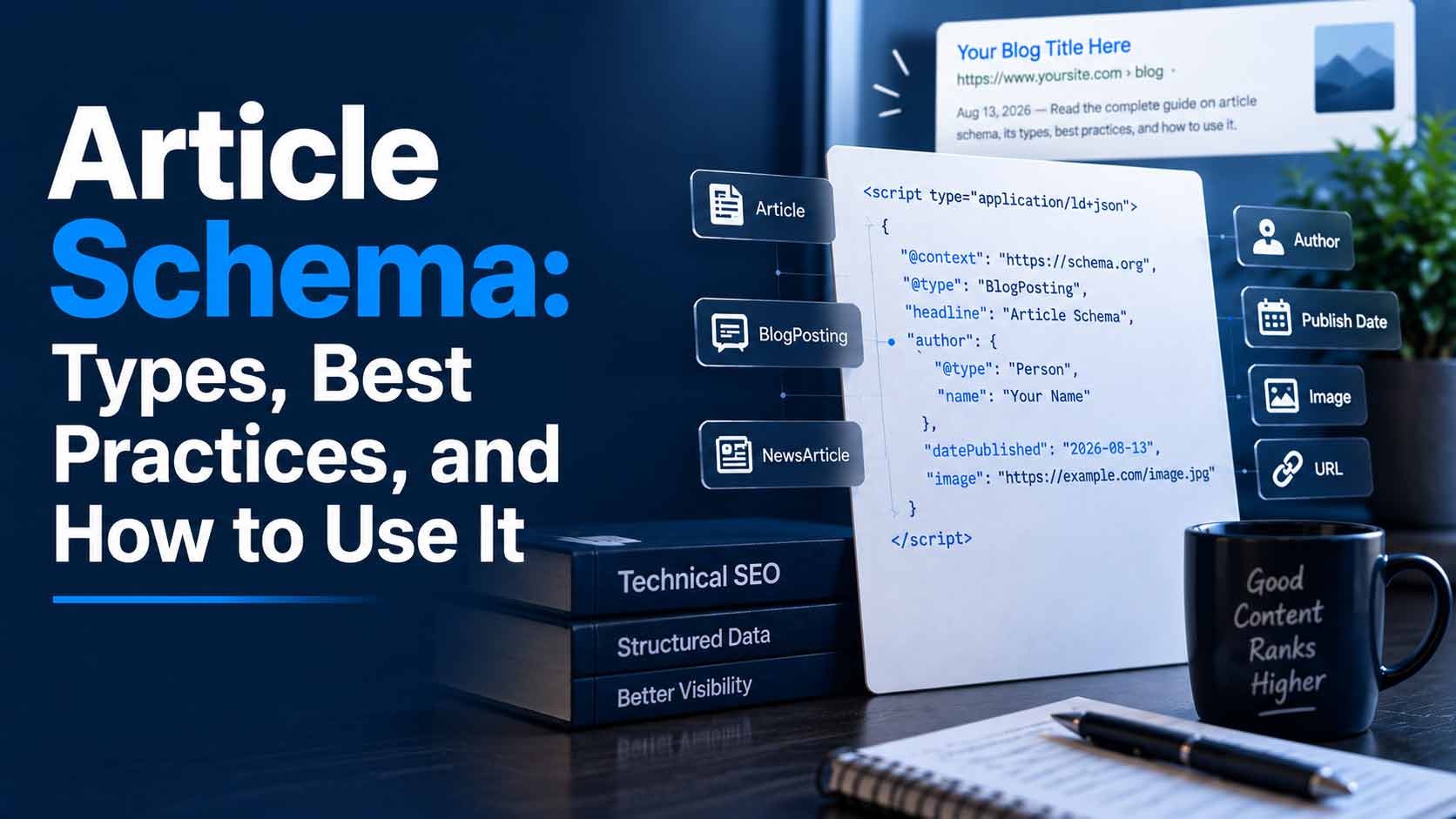
What Is Article Schema Markup?
Article schema markup is structured data that marks a page as an article, along with attributes associated with the article. It uses the vocabulary provided by Schema.org and is mostly applied via JSON-LD.
It’s like adding a layer of machine-friendly information.
The person reading an article can clearly understand that:
“This is a blog post by Sarah posted on 13 August 2026 and last modified today.”
A search engine can find similar content via structured data.
The following information can be shared via article markup:
- Article headline
- Author
- Post date
- Last modified date
- Featured image
- Publisher
- Article description
- Main entity
- URL
This doesn’t replace quality content. Instead, it gives search engines additional context about the content already present on the page.
OpenAI has not disclosed the ranking criteria for ChatGPT, so we cannot guarantee a top ranking on ChatGPT. First, make sure OAI-SearchBot is allowed to crawl your website. Next, create helpful, reliable, and clearly organised website content that addresses users' exact questions to the point. Multiple factors such as relevance are among those that ChatGPT may consider when ranking results, OpenAI revealed.
Make sure technical SEO, crawlability, search intent, topical authority, structured information, original content, and entity signals are your main focus. Since Gemini is part of Google, maintaining strong SEO fundamentals will remain key to Gemini's SEO and AI search visibility.
It must first be accessible on the technical front: topic clustering must be done, questions must be answered conversationally, entity signals must be enhanced, there must be proper structured data, unique insights must be provided, and third-party authorities must be cited to establish credibility.
AI SEO enhances regular SEO, but does not replace it. Technical SEO, content quality, crawling ability, link building, domain authority, and search intent still matter. The other aspect that comes into play is conversational discovery and citation by AI systems.